GRIDtRAVELER Labs — Field Notes Nº1
Type
A Research Synthesis · Cognitive Science · 2026

The human cost of outsourcing imagination

What happens to the mind when we hand creativity to a machine? The evidence draws one exacting line: the harm is not the tool — it is whether the human still does the generative work.

← Labs index Capabilities profile →
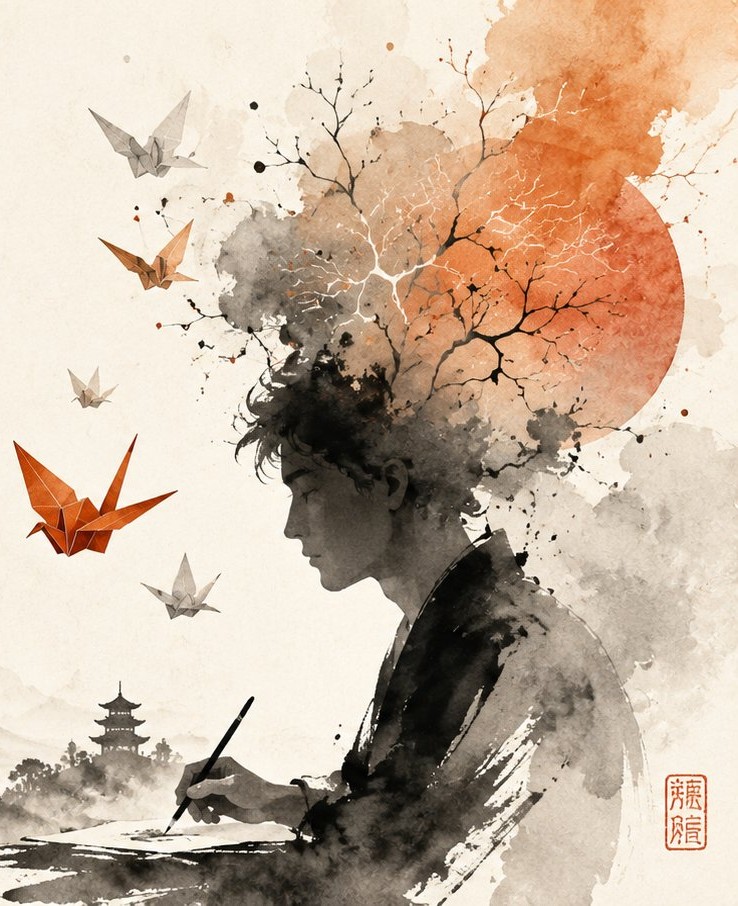
Ink-wash illustration of a figure writing by hand as origami cranes, a tree of branching neurons, and a red sun rise from the mind.
The 10-second version

AI is not the enemy of imagination.
Passive substitution is.

When humans generate first and use AI second, AI can amplify skill. When humans ask AI to generate first, the mind loses the exercise that builds memory, judgment, originality, and ownership.

Generate first. Then consult.

Abstract

The strongest current evidence shows that passive, substitutive delegation of creative work to AI measurably reduces neural engagement, weakens memory and critical thinking, and homogenizes ideas — while active, collaborative use can augment what a person produces. The deepest risks are not acute; they are slow and developmental, removing the very mental exercise that builds reserve and sustains meaning.

The dividing line

Generate first, then consult. When AI replaces the generative act instead of extending it, the benefit of doing the work disappears.

The slow erosion

Imagination builds the reserve that protects against decline. Outsource it and you remove the exercise — “use it or lose it.”

The honest caveat

The foundations are robust; the direct AI studies are recent and small. Treat the long-term claims as informed concern, not settled fact.

01Cognitive degeneration

The brain goes quiet when the machine does the thinking

Humans have always offloaded memory — to books, to partners, to the search bar. In moderation it is adaptive. But offloading changes what the brain retains, and creativity is the faculty most exposed, because it is built entirely from the act of generating.

In the MIT Media Lab’s Your Brain on ChatGPT study, fifty-four writers worked in one of three conditions. EEG showed brain-only writers had the strongest, most distributed connectivity; search users moderate; LLM users the weakest. LLM users reported the lowest ownership of their essays and often could not quote work they had just produced.

Kosmyna et al., MIT, 2025

An increase in individual creativity, at the risk of losing collective novelty.

Figure 1 · A mind, engaged and disengaged

The engaged mind fires densely. Switch to AI-assisted and the connections thin — the MIT study calls this cognitive debt.

Two behavioral studies reinforce the pattern: heavier AI reliance correlates with weaker critical thinking, mediated by cognitive offloading and concentrated in the young; and higher confidence in AI predicts less critical thinking, as effort shifts from creating to merely checking.

Gerlich 2025 · Lee et al., Microsoft & CMU, 2025
Figure 2 · Neural connectivity by writing condition
92
Brain-onlystrongest, distributed
58
Search enginemoderate
29
LLM-assistedweakest
Illustrative. A schematic of the study’s reported ordering of EEG connectivity, not exact magnitudes. The authors caution against language like “brain damage”: this captures task-time engagement, not proven permanent harm.

The mechanism is old and well-evidenced. The generation effect — a memory advantage of roughly half a standard deviation for material we produce ourselves over material we merely read — has held across eighty-six studies. AI that produces the sentence, the answer, or the image removes exactly that generative act. This is the bridge between “AI did it for me” and “I never learned it.”

Bertsch et al., 2007
02Idea homogenization

Everyone improves and the work grows the same

In a controlled experiment, writers given AI story ideas produced work rated more creative and enjoyable — especially weaker writers. But the AI-assisted stories were markedly more similar to one another. Individual creativity rose; collective novelty fell. The authors call it a social dilemma: each writer is better off, yet a narrower band of ideas survives.

Doshi & Hauser, Science Advances, 2024
Figure 3 · The social dilemma of assistance
Individual creativityCollective diversity
Individual
+18%
Collective
−11%
Illustrative model. As assistance climbs, the average story improves while the set of stories converges. Anchoring on statistically central suggestions narrows the raw material of culture — which then feeds back as training data and as examples we imitate.
03Mental & emotional cost

Creativity is protective — displacing it has a price

Creative expression is not a luxury for the mind; it is maintenance. Art-making lowers cortisol — in one study, three in four participants’ levels dropped after a forty-five-minute session. Flow, the total absorption in a challenge matched to skill, reliably tracks with happiness, intrinsic motivation and emotional regulation.

Kaimal et al., 2016

But flow requires the struggle. The best moments arrive when mind or body is stretched to its limit in a voluntary effort to do something difficult and worthwhile. Instant generation removes the struggle that produces the reward — a structural threat to the very state that makes creative work nourishing.

For professional artists the cost is already visible. In a survey of 378 verified visual artists, ninety-nine percent disliked generative AI, with open responses describing demoralization, fear, and younger artists leaving the field. And heavy reliance on AI companions shows a comfort-then-distress pattern, with the heaviest users reporting more loneliness.

Jiang et al., 2024 · Fang et al., 2025
04Physical & embodied loss

The hand teaches the brain — the prompt does not

The physical risks are mostly indirect, and they run through the body. Handwriting produces far more elaborate brain connectivity than typing, engaging parietal and central regions tied to memory and learning that keyboarding barely touches. Musical practice drives structural plasticity; craft and drawing track with reduced dementia risk and higher cognitive reserve.

van der Weel & van der Meer, 2024

Prompt-only generation bypasses the fine-motor, sensorimotor and sustained-attention work that gives these activities their neurological value. Add the reward asymmetry — effortless instant output versus the delayed, effortful reward of making by hand — and the pull toward passive consumption is built in.

Figure 4 · Cortical activation — by hand vs. by keyboard
Schematic. Density of lit nodes illustrates the qualitative finding that handwriting recruits widespread, connected activation while typing engages far less. Not an anatomical map.
05Children & development

The highest stakes — the least studied

Imagination is built through play and effort. Pretend play supports executive function, self-regulation, language and social cognition; the generation effect and effortful learning are the engine of education — exactly what AI homework completion can short-circuit.

Children are heavy adopters and barely studied. The leading close study of children’s creative process with AI watched just twelve seven-to-thirteen-year-olds — and caught a red flag: children abandoned their own ideas to match what the AI could produce. Asked about AI authorship, one eleven-year-old said it would “dismantle” the joy of reading for him.

Newman et al., University of Washington, 2024
Figure 5 · Adolescent adoption, United States
70%
have used a generative AI tool
72%
have used an AI companion
52%
are regular companion users
13%
use a companion every day
Common Sense Media, 2024–2025. Adoption is near-universal among teens, yet there is still no large controlled study of AI’s effect on children’s creativity — the urgent gap in the entire field.
06Counterpoints & nuance

The same tool cuts both ways

The evidence is genuinely two-sided, and rigor demands the protective conditions be stated plainly. AI can keep critical thinking sharp when users stay vigilant verifiers; it can rescue a blocked writer; it can lift novices. The variable that decides harm or help is not the technology — it is whether the person still generates, or merely receives.

Figure 6 · What decides the outcome
Used as a collaborator, AI amplifies human judgment.
07Practical guidance

How to keep the faculty you are tempted to outsource

i.

Generate first, then consult

Produce your own draft, sketch or solution before opening AI, then use it to critique or extend. This preserves the generation effect and your sense of ownership.

For individuals
ii.

Make it question you

Use AI as a Socratic partner, not an answer machine. Treat its first output as a point to diverge from, never an anchor to settle on.

For individuals
iii.

Protect the hand

Keep effortful, embodied practice — handwriting, an instrument, drawing, craft — as deliberate cognitive exercise. The benefit lives in the doing.

For individuals
iv.

Watch the dependency signals

Declining ability to work unaided, loss of flow and enjoyment, emotional reliance, less real-world contact — thresholds for a deliberate AI fast.

For individuals
v.

Design school use developmental

Assess process and reasoning, not just output. Require students to generate before they prompt. Teach AI literacy and verification as core skills.

For educators
vi.

Keep childhood mostly offline

Protect unstructured imaginative play and handwriting as non-negotiable developmental infrastructure — children themselves tend to prefer offline tools.

For parents

Read these findings honestly

Create, then consult Amplification
Consult instead of creating Erosion

The mind is built to generate — not only to receive.

The evidence base

Sources, in full — expand any entry

A1Your Brain on ChatGPT — neural cost of LLM-assisted writing+
Kosmyna et al. · MIT Media Lab · arXiv 2506.08872 · 2025 · n = 54, EEG
Across three writing conditions, brain-only writers showed the strongest, most distributed EEG connectivity and LLM users the weakest. LLM users reported the lowest ownership and often could not quote what they had written — “cognitive debt.” A preprint with a small final sample; single model and task. The authors discourage sensational framing.
A2AI tool use, cognitive offloading, and critical thinking+
Gerlich · Societies 15(1):6 · January 2025 · n = 666, UK
A significant negative correlation between frequent AI use and critical-thinking scores, mediated by cognitive offloading and strongest among the youngest cohort. Higher education buffered the effect. Correlational design.
A3Generative AI and the erosion of critical thinking at work+
Lee et al. · Microsoft Research & Carnegie Mellon · CHI 2025 · 319 knowledge workers
Higher confidence in AI predicted less critical thinking; higher self-confidence predicted more. Effort shifts from material production to critical integration, and AI users produced a less diverse set of outcomes — Bainbridge’s “irony of automation.”
A4Generative AI enhances individual but reduces collective novelty+
Doshi & Hauser · Science Advances 10(28):eadn5290 · July 2024 · n = 293
AI story ideas raised individual creativity and enjoyment, especially for less-creative writers, while making stories markedly more similar — a social dilemma in which writers are individually better off but collective novelty narrows. A randomized experiment.
A5The generation effect — memory advantage for self-produced material+
Bertsch, Pesta, Wiscott & McDaniel · Memory & Cognition 35(2) · 2007 · 86 studies
A meta-analytic advantage of about 0.40 standard deviations for generated over read material — the foundational reason that removing the generative act removes the learning. Originating work: Slamecka & Graf, 1978.
A6Cognitive offloading: navigation and the “Google effect”+
Dahmani & Bohbot · Scientific Reports · 2020 · Sparrow, Liu & Wegner · Science · 2011
Greater lifetime GPS use is associated with worse spatial memory and steeper decline in hippocampal-dependent navigation. Separately, expecting future digital access reduces recall while improving memory for where to find it.
A7Handwriting vs. typing: cortical connectivity+
van der Weel & van der Meer · Frontiers in Psychology · 2024 · n = 36, 256-channel EEG
Handwriting produced far more elaborate, widespread brain connectivity than typing, engaging parietal and central regions linked to memory and learning that typing barely activated.
A8Art-making and cortisol reduction+
Kaimal, Ray & Muniz · Art Therapy 33(2):74–80 · 2016 · n = 39
Three in four participants showed lower cortisol after a 45-minute art-making session — a statistically significant drop, independent of prior artistic experience.
A9Professional artists and generative AI+
Jiang, Taylor & Agnew · CHI Extended Abstracts · 2024 · n = 378
Ninety-nine percent disliked generative AI; open responses describe demoralization, fear, and younger artists leaving the field. The psychological harm is better-evidenced than mass economic displacement, which remains contested.
A10AI companions and emotional reliance+
Fang et al. · MIT & OpenAI RCT · 2025 · Yuan et al. · Replika study · 2025
Heavy daily chatbot use correlated with greater loneliness, dependence and reduced real-world socializing; companion effects are highly context-dependent — comfort for some, deepened distress over time for others.
A11Children, AI, and the creative process+
Newman et al. · University of Washington · CHI 2024 · Common Sense Media · 2024–2025
A small qualitative study found children abandoning their own ideas to match AI output. Adoption: 70% of teens have used a generative AI tool; 72% have tried an AI companion, 52% regular users, 13% daily. No large controlled study yet exists.